YouTube Competitor Analysis: How to Validate a Faceless Niche Before You Build the Channel
The most expensive mistake in faceless YouTube is not a bad thumbnail. It is entering a niche that closed months ago.

You see an animal channel pulling millions of views, so you make animal videos. You see police, fire trucks, snakes, tigers and dinosaurs getting recommended everywhere, so you remake the same concepts. It sounds reasonable. It usually is not, because a niche that looks healthy from the outside can already be saturated, cloned by hundreds of channels, or in a state where the algorithm only feeds a handful of incumbents and lets everyone else starve.
That is why YouTube competitor analysis is the step I refuse to skip. I have been building faceless channels for English-speaking audiences since 2017, and the pattern is consistent: you can recover from a weak thumbnail, a bad title or a flat voiceover. Those are fixable over a few uploads. Choosing the wrong market is not something you fix; it is something you restart.
This is the process I run before producing a single video. It answers five questions: is there still room here, can a new channel grow, what exactly are the incumbents winning on, how do I remake without being read as spam, and should I enter this market at all?
Why analysis beats getting your first video out
New creators are impatient. An idea arrives and within an hour the editor is open, the model is generating imagery, the voice is rendering. I understand the feeling. Every day without an upload feels like falling behind.
But YouTube does not reward the fastest producer. It rewards whoever understands the market best. A beautiful AI video can get no views. A long script can fail to hold anyone. A channel that uploads relentlessly can still never get recommended, because YouTube is fundamentally a system for distributing attention, and it will not distribute yours if the market has stopped wanting that content or if fifty channels are already making it identically.
Competitor analysis is not about copying. It is about verifying four things before you commit: real viewers exist, the algorithm is still pushing this format, new channels can still grow, and you can produce a version that is genuinely better.
1. Read the big channels with the rule of the majority
Start with the largest channels in the space. They have been validated by the market already: real data, millions of views, a growth history and a clear relationship with the algorithm.
But do not copy the channel wholesale. What you need is narrower and more useful: which slice of their catalogue carries most of their views.
Which channels to study
Prioritise channels doing roughly five million views a month, or around three million if the niche is narrow, that are still uploading, are not in visible decline, and have many recommended videos rather than one lucky outlier.
Why five million a month? Because it separates sustained demand from a lucky streak. Any channel can catch one hit. A channel holding millions of views month after month is serving something people actually want. That distinction matters enormously in AI-assisted niches, where formats can spike for a fortnight and die just as fast. You do not want to enter a wave that already broke.
Break down their top twelve
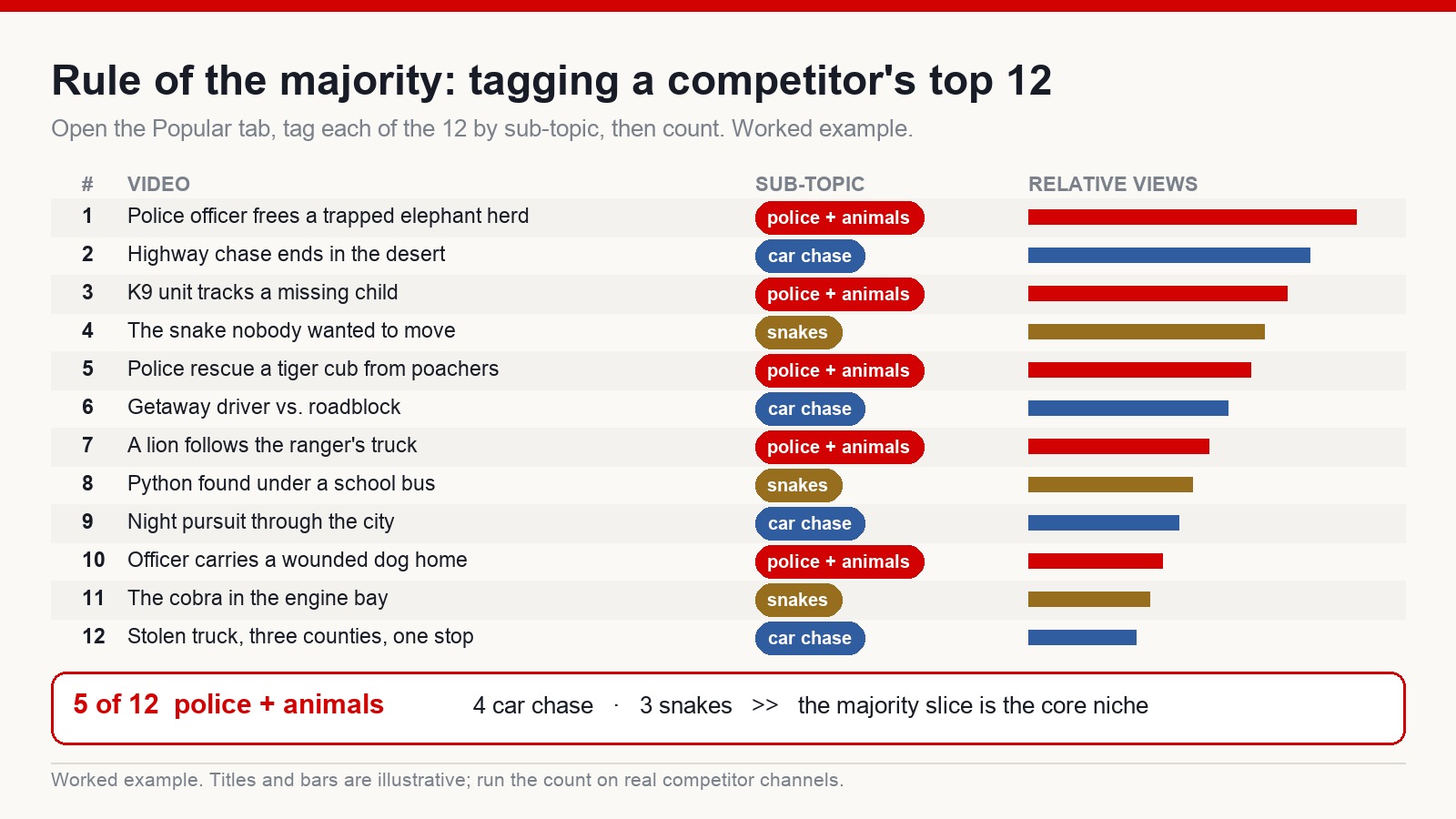
Open the channel’s Popular tab and take the twelve highest-viewed videos. Do not eyeball it. Write each one down and tag it with a sub-topic.
Suppose the twelve break down like this: three videos about snakes, four about car chases, five about police and animals. Most people would conclude “this is a general animal channel”. Look more carefully and the strongest slice is not animals in general. It is police and animals, holding five of twelve. That is the sub-topic the algorithm is pushing hardest, and almost certainly the one holding attention best on that channel.
Why this beats picking what you like
Choosing by personal taste is the most common error I see. You like snakes, so you do snakes. You like supercars, so you do car content. A dinosaur video looked impressive, so you make dinosaurs.
YouTube does not care what you like. It cares whether viewers click, keep watching, engage and come back. Tagging the top twelve is how you let data speak instead of preference. It protects you from the most dangerous sentence in this business: “I think this niche is good.” The questions worth asking are whether the market is watching, whether the incumbents are still being pushed, which format holds the majority of views, and whether newcomers are managing to ride the same wave.
2. Remake on a 4:1 or 3:1 ratio
Once you know the strongest slice, do not remake at random. A lot of new channels die from chaotic publishing: snakes today, a police chase tomorrow, a monkey rescue next week, then zombies, then a K9 story.
It looks varied. To YouTube it looks incoherent, and the system has no idea which audience to show you to. For a new channel, early signal is close to everything.
The 4:1 pattern
If the core is police and animals, publish in this shape:
- Video 1: an officer rescues a dog from a criminal gang
- Video 2: police and a tiger corner a suspect
- Video 3: a K9 unit finds a missing child
- Video 4: officers protect wildlife from poachers
- Video 5: a city car chase, taken from the adjacent cluster in the top twelve
Four core, one adjacent. You stay legible to the algorithm while still testing a neighbouring audience.
When to use 3:1
If you want to test faster, three core plus one adjacent works. On a very new channel I still prefer 4:1, because positioning is worth more than exploration in the first twenty uploads.
Remaking is not copying
This is where people need to be clear-eyed. A remake is not the same idea with new images and a different narrator. That gets read as repetitive, low-value content, and it deserves to be.
A real remake keeps the structure that won, understands why it won, and then builds a new version with its own angle, situation, pacing and message. If a competitor made “Police officer saves a dog from a thief”, the lazy move is the same story with different footage. The useful move is something like “The abandoned dog that helped police crack a major case”. Same niche, same audience, a story that is genuinely yours.
3. Validate the niche against direct competitors
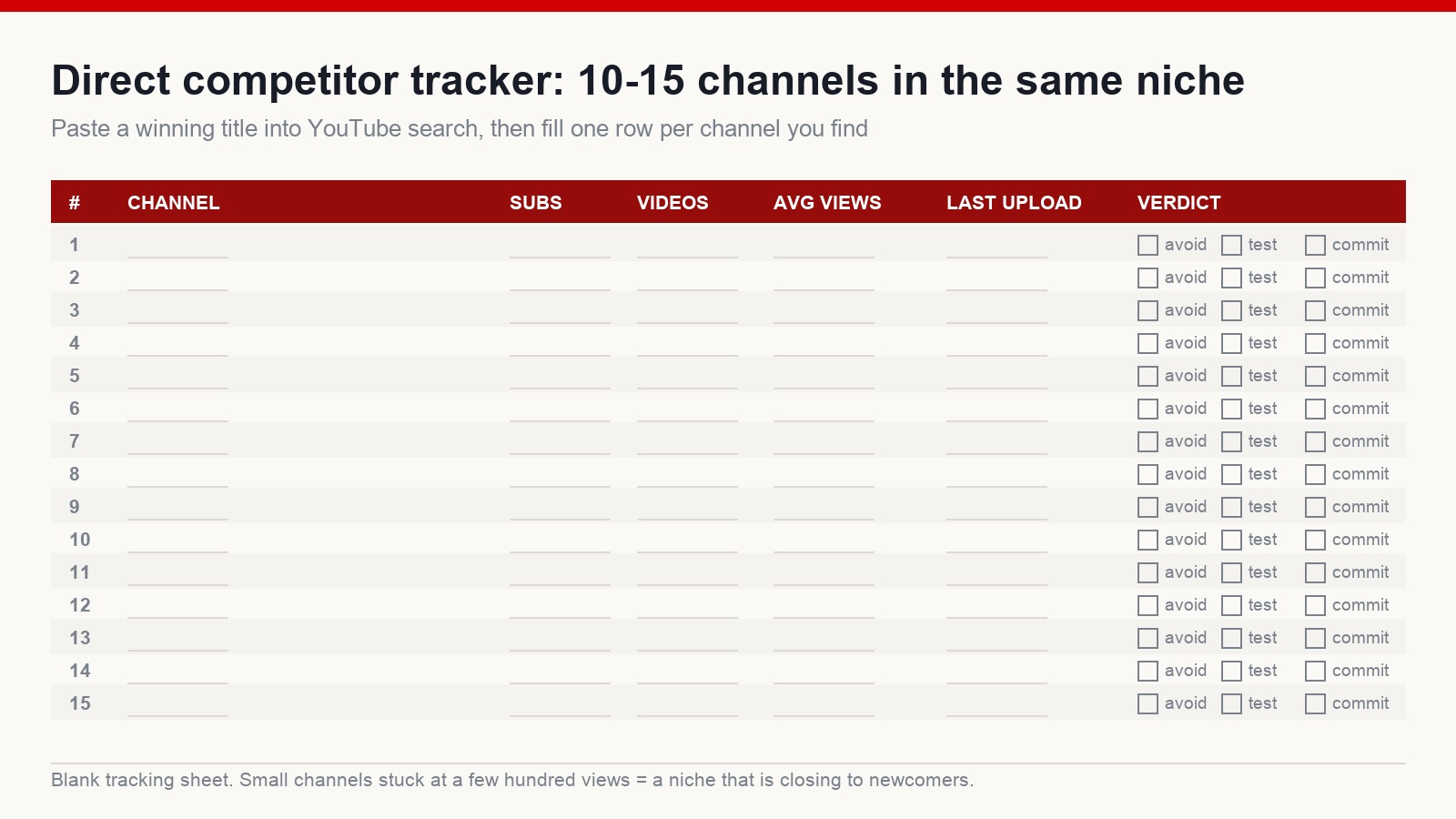
Big channels prove that demand exists. They do not prove you can get in. For that you need to know whether small channels can still grow here, and this is the step almost everyone skips.
Some niches look wonderful at the top and are lethal underneath, because the algorithm favours established brands, because viewers are attached to two or three incumbent formats, because the concept has been cloned to exhaustion, or because the thumbnail and title language has gone stale.
How to find 10 to 15 direct competitors
The simplest method: copy the title of a viral video from a big channel and paste it into YouTube search. You will surface remakes and same-concept videos from smaller channels. Open each one and log the channel name, subscriber count, video count, typical views, date of the most recent upload, main sub-topic, whether thumbnails look interchangeable, whether titles follow one rigid formula, and whether the channel is still active at all.
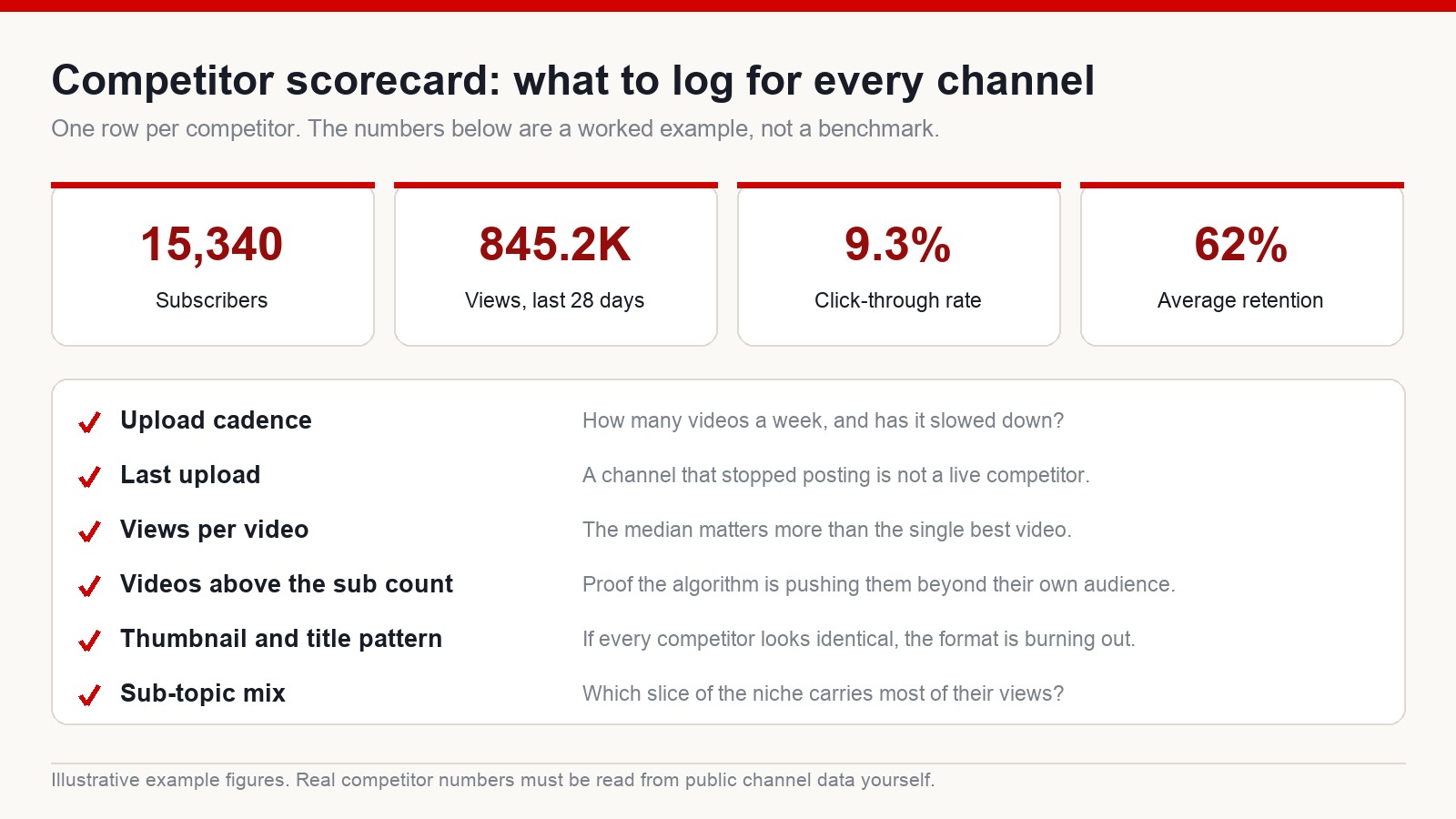
Research extensions and public analytics tools speed this up, and there are plenty of them. But you can do the whole thing manually, and honestly, doing it manually the first few times gives you a better feel for the market than any dashboard will.
Signals that say stay out
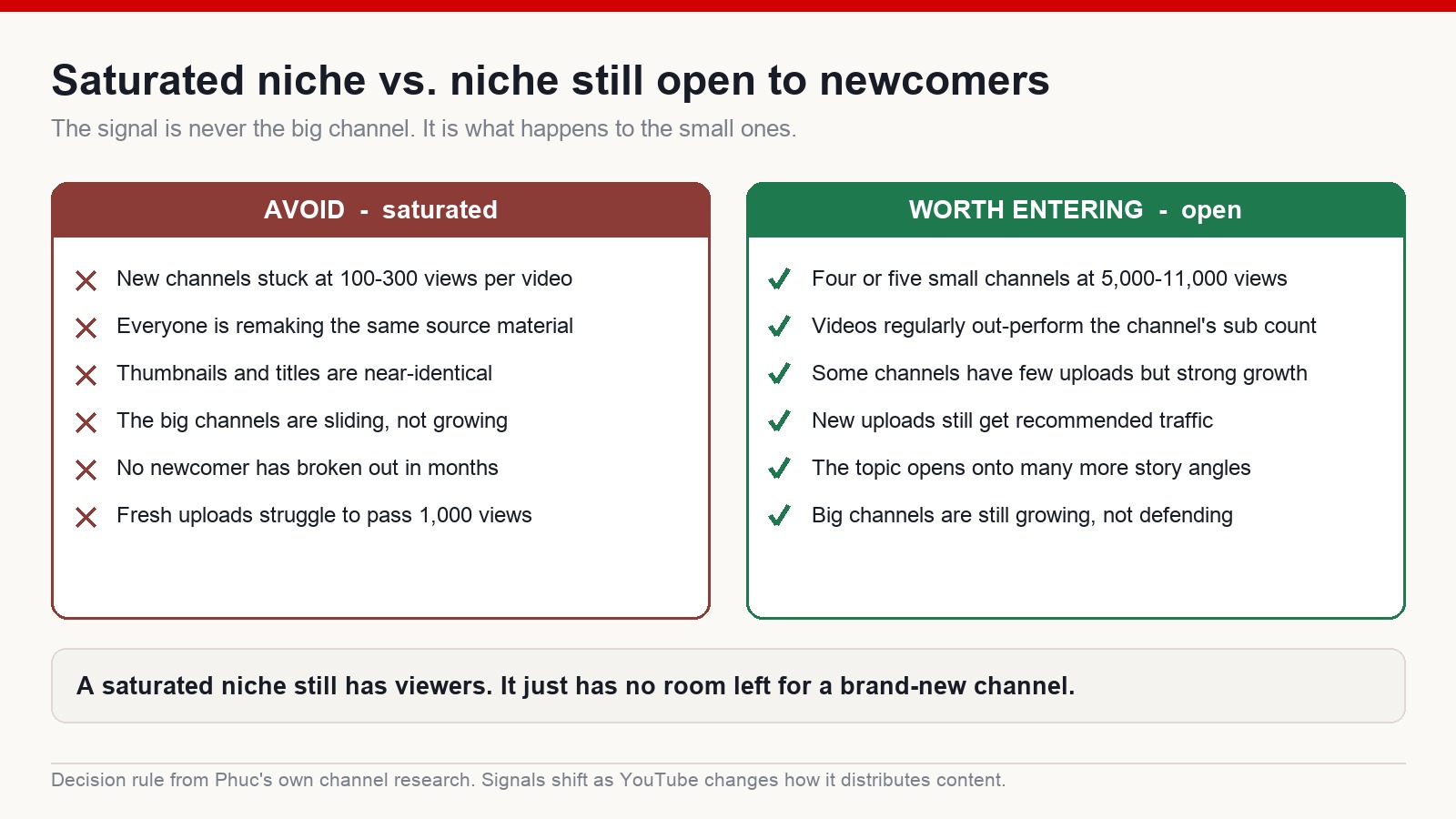
Once the list of 10 to 15 is built, read their results. If most newcomers sit at 100, 200 or 300 views per video, upload consistently and never move, share near-identical thumbnails, recycle the same title formula and publish plenty while earning almost nothing, that is a bad sign.
It usually means the niche is crowded, everyone is remaking the same source, viewers are bored of the format, and the algorithm has stopped opening the door for new entrants. When you see that, do not be stubborn. A saturated niche does not mean nobody is watching. It means a newcomer will struggle to get in, and forcing it costs you months plus every dollar you spend on tooling, narration, editing and thumbnail testing.
Signals that say there is room
The opposite pattern is what you want. Among your 10 to 15, four or five small channels are landing steady results, maybe 5,000, 8,000 or 11,000 views per video. Some have videos out-performing their own subscriber counts. They are still uploading. New videos still get views. A few have small catalogues but fast-growing audiences.
Not everyone has to be winning. A handful of small channels succeeding is enough to prove the market has not closed. Those are the niches I like most, because the evidence says the algorithm is still willing to take a chance on someone new.
4. Look for small channels punching above their weight
The single best signal in this entire process is a small channel growing fast: modest catalogue, unremarkable subscriber count, and videos hitting 50,000, 100,000 or 300,000 views.
It proves the niche is not reserved for incumbents. And these channels are far more instructive than the giants, because they are solving the same problem you have right now. Study how they open, how they package thumbnails, how they phrase titles, how long their videos run, how quickly they cut, what they do in the first thirty seconds, how they build tension, and how they use music and narration.
Big channels tell you where the market is. Small channels that are rising tell you how to get into it.
5. Use AI to analyse content and style
By this point you know which niche has viewers, which big channels are winning, which small channels are rising, what to focus on and what to avoid. One important question remains: why do their videos actually win?
If you only look at view counts and remake the surface, you will produce something bland. To do better, analyse the content itself, and this is where AI genuinely earns its place.
Analysing a competitor video with AI
Paste a competitor’s video link into a model such as Gemini and ask it to break down the main content, story structure, opening hook, emotional pacing, tone, core message, retention beats, what makes a viewer keep watching, the recurring character or situation types, and how the climax is constructed.
A prompt worth reusing: “Analyse this video as a YouTube strategist. Explain why it holds attention, what the storytelling structure is, where the hook sits, and how I could build a meaningfully different version.”
That shifts you from imitation to understanding. You stop asking what the thumbnail looked like and start asking what emotion carried the video, what situation, which character, which twist, which unanswered question. That is the part worth learning.
Writing a stronger script from that analysis
Then use the analysis to build something new. Do not prompt “rewrite this video” — that instruction is far too weak. Ask for something specific: “Write a new script for the same audience as the source video, but change the setting, the characters, the climax and the message. It needs a strong hook in the first five seconds, fast narrative pacing, several retention beats, and it should suit an eight-minute faceless video.”
Now you are upgrading rather than cloning, and that line is the difference between a channel that lasts and one that lives or dies with a short-lived trend.
6. Harvest competitor keywords
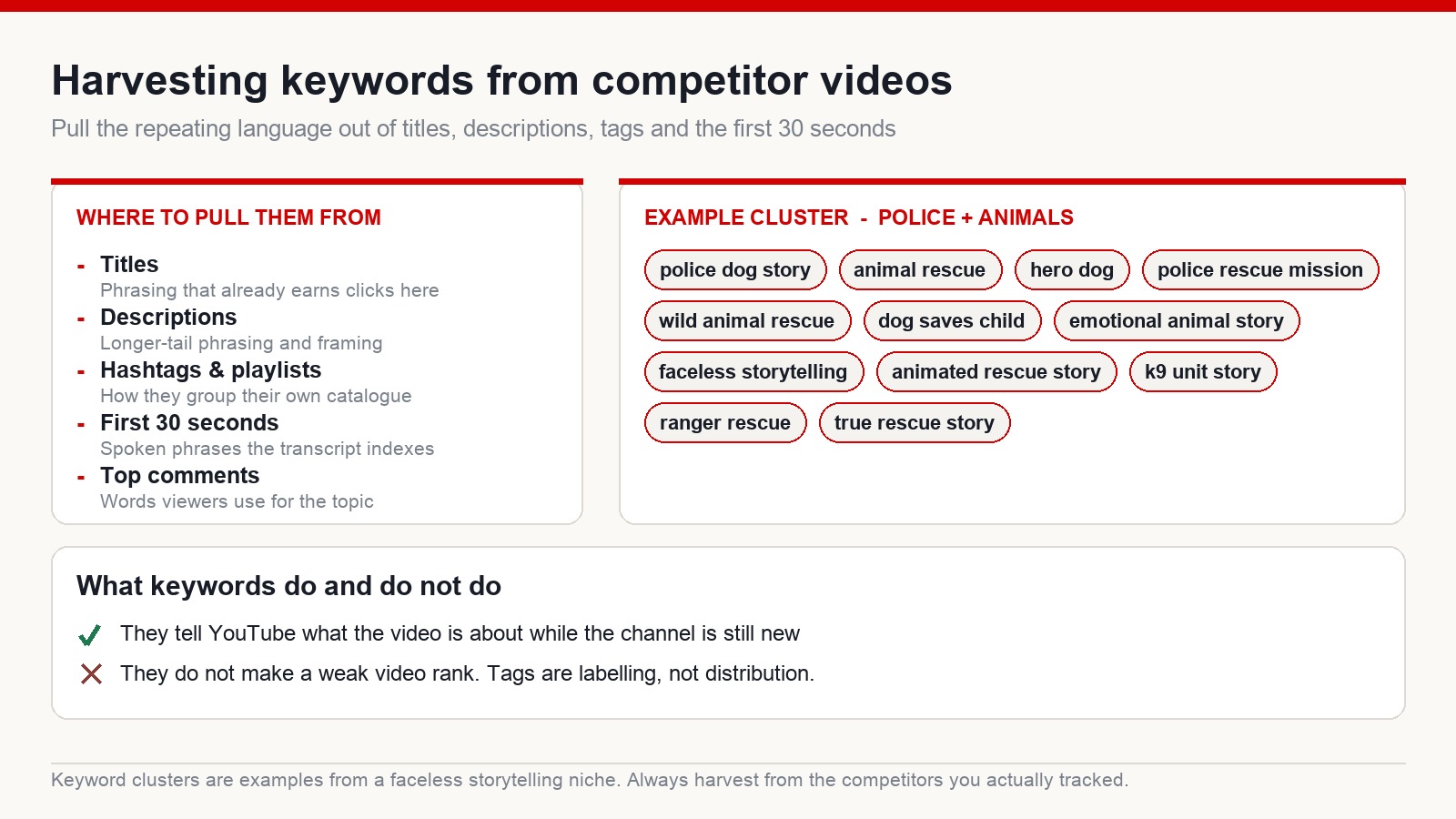
Many faceless creators focus purely on recommendations. That is correct but incomplete. In evergreen niches especially, search still matters, and beyond traffic, keywords help YouTube work out what your video is about.
While analysing competitors, pay attention to titles, descriptions, hashtags, repeated phrases, the subject shown in thumbnails, the words spoken in the first thirty seconds, viewer comments and the channel’s playlists.
You can use AI to consolidate roughly 25 related keywords from several competitor videos. For a police-and-animals niche the cluster might look like: police dog story, animal rescue, hero dog, police rescue mission, wild animal rescue, dog saves child, emotional animal story, faceless storytelling, animated rescue story.
Keywords are only one input. Attaching 25 tags will not make a video travel; YouTube has not worked that way for a long time. But good keywords position a video more clearly, which matters most while your channel is new and the system has no history to judge you on.
7. Treat market research as maintenance
Another common failure is analysing once, then producing with your head down for six months. Faceless and AI-assisted niches move fast. A format that feels fresh today can be full of clones next month. A tool producing distinctive imagery this week is in everyone’s pipeline by next. A thumbnail style with high CTR eventually stops registering at all.
Keep a standing research checklist and revisit it weekly: the big channels in your niche, the small channels growing fastest, communities where creators share what is working, channels that cover AI tooling, new imagery, voice and animation trends, videos with unusual view spikes, and thumbnail styles being cloned heavily.
The goal is not to chase every trend. It is to know which direction the market is moving. Creators who last are not only producers; they are observers, and the better you observe, the less you have to guess.
8. Making the decision: three verdicts
After all of the above, decide. I sort niches into three groups.
Avoid
Big channels that used to be strong are declining. Small channels remake in bulk and get very little. New videos struggle past 1,000 views. Thumbnails and titles are interchangeable. No newcomer has broken out recently. The topic has been repeated to death. Stay out unless you have a genuinely different angle.
Test small
Signals are mixed. Big channels still get views. A few small ones do reasonably. It is not strong enough to commit. Publish 5 to 10 videos and watch what happens before you spend heavily on narration, editing, assets or hiring.
Commit
Big channels are still growing. Small channels can still break through. Four or five direct competitors hold steady view counts. Some channels have few uploads but strong results. The topic supports many more stories. Viewers respond. New uploads still get recommended. This is where a content system is worth building — while remembering that the goal is a better version, not a duplicate.
The pre-launch checklist
- Find 3 to 5 large channels in the niche
- Prefer channels above roughly five million views a month
- Break down their twelve most popular videos
- Identify the sub-topic holding the majority
- Search winning titles to surface remake channels
- List 10 to 15 direct competitors
- Check the average views of the small channels
- Look for 4 to 5 with steady results
- Look for small catalogues with outsized view counts
- Analyse hooks, thumbnails, titles and story structure
- Use AI to analyse content and style
- Write a script that is meaningfully different
- Consolidate roughly 25 related keywords
- Publish on a 4:1 or 3:1 ratio
- Re-check the market weekly
Common mistakes in competitor analysis
Looking at the viral video instead of the channel. One hit proves very little. If a channel has 100 videos and one breakout, that is probably luck. If many videos consistently clear the channel’s own average, that is a signal.
Copying the topic without understanding the win. People see a dog-rescue video with ten million views and immediately make a dog-rescue video. They miss that it won on a strong hook, a real twist, a curiosity-driven thumbnail, a title that hit an emotion, tight pacing and music doing genuine work. Copy the topic without the retention logic and nothing happens.
Never checking the small channels. The most dangerous omission. The incumbents look great, so you enter a market where only the incumbents survive and every newcomer is buried.
Running too many niches at once. A new channel needs a clear signal. Test too broadly and YouTube cannot tell who you serve. Hold one slice, then widen slowly.
Analysis is not about copying. It is about survival.
Faceless YouTube is no longer a game you win by knowing the tools. AI made production easy, and because it made production easy, competition became severe. The winner is rarely whoever edits most beautifully. It is whoever picks the right market, reads it accurately, understands the competition deeply and ships a version worth more of a viewer’s time.
Competitor analysis exists to prevent the most expensive mistake available to you: choosing the wrong market. Before you make 50 videos, study 50 competitors. Before you scale, validate. Before you remake, understand why the original won.
One honest caveat: none of this is a guarantee. Niches saturate, YouTube changes how it distributes content, and well-researched channels still fail. What research buys you is better odds and fewer wasted months, not certainty.
Frequently asked questions
What is YouTube competitor analysis?
It is the process of studying channels already working in a niche to understand why they win, whether the market still has room, whether new channels can grow, and what kind of content you should produce.
How many competitors should I analyse?
At minimum 3 to 5 large channels and 10 to 15 small direct competitors. The large ones confirm demand exists. The small ones tell you whether a newcomer still has a path.
How do I know a niche is saturated?
When most new channels sit at 100 to 200 views, publish consistently without growing, and thumbnails and titles have been cloned to the point of interchangeability, the niche is likely saturated or very difficult to enter.
When is a niche worth committing to?
When the big channels are still growing, at least four or five small channels hold steady view counts, new uploads still get recommended, and the topic supports many more content angles.
Will remaking competitor videos get me flagged as spam?
It can, if you copy mechanically and reproduce the content, imagery, titles and structure almost identically. Remaking is safer when you keep the underlying success logic but change the setting, characters, story, script, pacing and message. Read YouTube’s own policies on repetitious content before you scale.
Should I use AI to analyse competitor videos?
Yes. Models like Gemini are useful for breaking down structure, hooks, storytelling, tone and retention beats. Treat it as support, not verdict — you still judge the market on real data.
What does a 4:1 publishing ratio mean?
Four videos in your core niche plus one in an adjacent sub-topic. It keeps your channel signal clear for the algorithm while leaving room to test new subjects.
Should a beginner pick a broad niche?
No. A new channel needs a clearly defined slice. Instead of “animals”, go with something like “police and animals”, “K9 rescue stories” or “wildlife rescuing people”.
Start with the market, not with your preferences
If you are about to build a faceless channel, do not open with “what content do I enjoy making?” Open with: what is the market watching, is there still room for a new channel, and how could I make a better version?
That question is what separates creators who last from creators who quit after thirty uploads. If you want the full system for building a faceless channel aimed at international audiences, the training is at mmoyoutube.com.